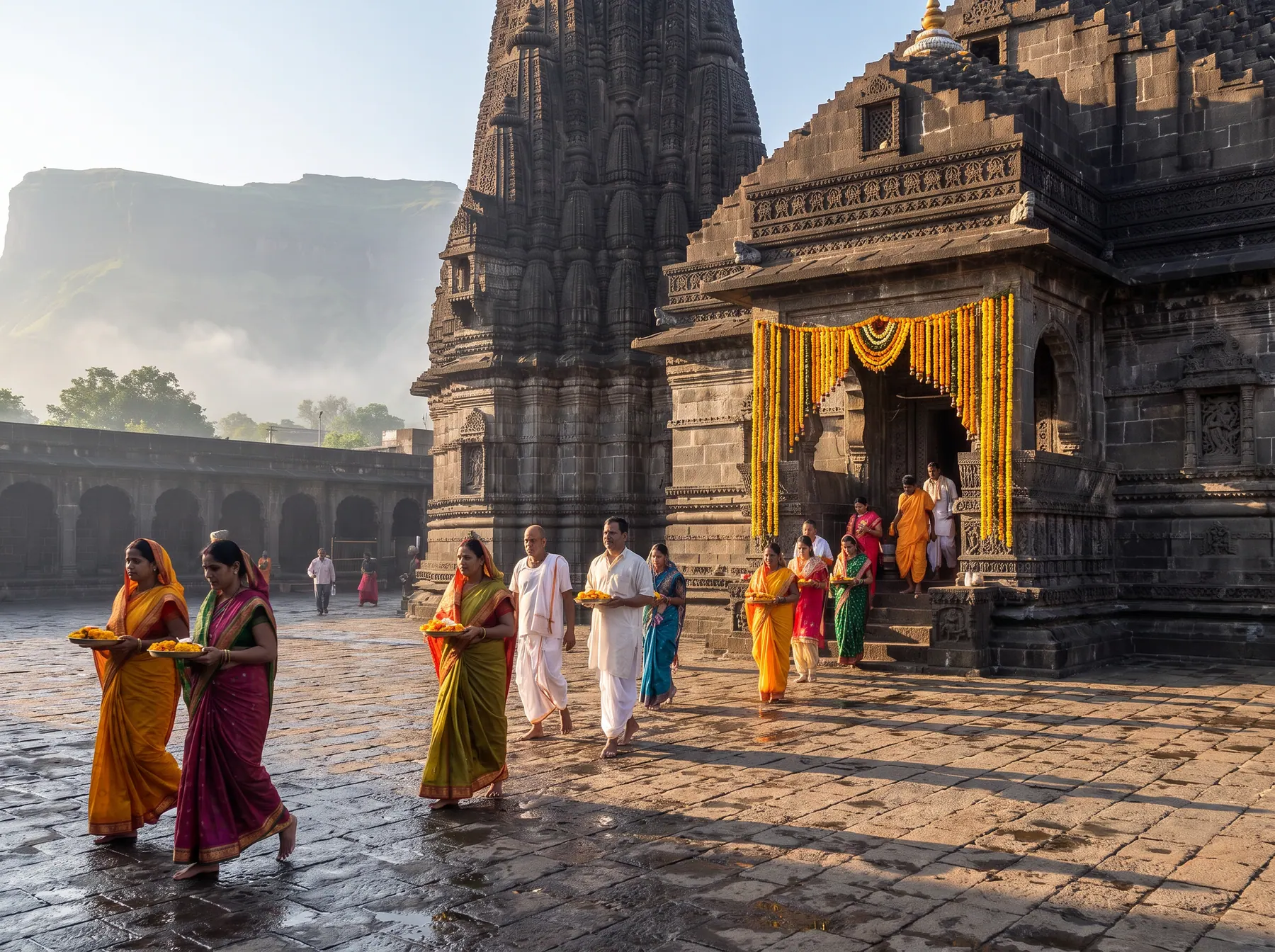
Trimbakeshwar is a small temple town at the foot of the Brahmagiri hills, about 28 to 30 km from Nashik in Maharashtra. It is home to one of the twelve Jyotirlingas of Lord Shiva, and to Kushavarta Tirth, regarded as the sacred source of the river Godavari. For centuries pilgrims have come here for darshan, for a bath in the Godavari's first waters, and for ancestral rites that this town is especially known for. This article brings together what is known of its history, and separates legend from recorded fact so that you can appreciate both.
The name: Tryambaka, the three-eyed Lord
The town's name comes from Tryambaka, an ancient name of Shiva usually understood as "the three-eyed one". The same word opens the Maha Mrityunjaya mantra of the Rigveda, Tryambakam yajamahe. Over time the name has been written in many ways (Trimbak, Tryambak, Trambak, Tryambakeshwar, Trimbakeshwar), but all refer to the same Lord and the same place. In the well-known hymn that lists the twelve Jyotirlingas, Trimbakeshwar is remembered as Tryambakam Gautami-tate: Tryambaka on the banks of the Gautami, another name of the Godavari.
The legend of Gautama and the Godavari
The sacred story of Trimbakeshwar begins with the sage Gautama and his wife Ahalya, who lived on Brahmagiri. According to the legend, during a long drought Gautama's hermitage remained blessed with water and grain, and he shared it with everyone. A cow strayed into his field, and when he tried to drive it away with a blade of grass it fell dead. Though the death was unintended, Gautama took on the fault of having caused it. He performed intense penance to Shiva and prayed for the Ganga to come down and purify the place.
Pleased, Shiva released the Ganga on Brahmagiri. She flowed as the Godavari, also called the Gautami after the sage. The legend adds that, at Gautama's prayer, Shiva agreed to remain here as Tryambakeshwar. The Godavari's story is told in detail in the Gautami Mahatmya, traditionally included in the Brahma Purana; you can read more in our article on the origin of the Godavari.
An older shrine, and the Peshwa-era temple
Worship at Trimbakeshwar is far older than the present building. The temple that stands today was built on the site of an earlier shrine, which, according to historical accounts, was damaged in the late seventeenth century during the Mughal campaigns in the Deccan.
The present temple was built under the third Peshwa, Balaji Bajirao, also known as Nanasaheb Peshwa, who led the Maratha administration from 1740. According to the Shri Trimbakeshwar Devasthan Trust, the temple opened on Mahashivratri, 16 February 1756, with celebrations accompanied by traditional instruments such as the sanai and chaughada. It is built of dark basalt, the stone of the Deccan, and its tall spire, carved walls and enclosed courtyard make it one of the finest examples of temple architecture of the Peshwa era. A popular story connects the rebuilding with a wager the Peshwa is said to have lost over whether the stone around the Jyotirlinga was hollow; it proved to be hollow.
The Jyotirlinga with three faces
What makes Trimbakeshwar unique among the Jyotirlingas is the form of the linga. Instead of a single raised linga, the sanctum holds a small hollow at floor level in which three small lingas, or faces, are worshipped, representing Brahma, Vishnu and Shiva. For this reason the temple is often described as honouring the whole Trimurti. Water is traditionally said to well up within the hollow, and excessive use of water has caused some erosion of the linga over time. At set times the linga is covered with a jewelled crown and a gold mask of the three deities. Accounts also link the famous Nassak Diamond with the temple; it is said to have left Trimbak around the time of the Anglo-Maratha war of 1817 to 1818.
Kushavarta Tirth
A short walk from the temple lies Kushavarta, the sacred tank regarded as the point where the Godavari, having come down from Brahmagiri, gathers as a holy river. Its name is traditionally explained by the legend that Gautama bound the river here with kusha grass so she would not disappear again. The present kund, with its stone steps and surrounding verandahs, was built by Shrimant Sardar Raosaheb Parnerkar, Fadnavis of the Indore State. Kushavarta is where most ritual days at Trimbakeshwar begin, with a purifying bath before the pooja.
Trimbak and the Kumbh Mela
Trimbakeshwar is one of the four places of the Kumbh Mela. The Kumbh held here is called the Simhastha, because it falls when Jupiter is in Simha (Leo), roughly once in twelve years. Historically the Kumbh was held at Trimbak; after a clash over bathing precedence in 1789, the Vaishnava akhadas were given Ramkund in Nashik for their bath, while the Shaiva akhadas continue to bathe at Kushavarta in Trimbak. The latest Simhastha period formally began with the flag hoisting on 31 October 2026, with the main Amrit Snan days announced for August and September 2027.
Saints, forts and the trust
Trimbakeshwar is also sacred to the Varkari tradition of Maharashtra. Sant Nivruttinath, elder brother and guru of Sant Dnyaneshwar, took sanjivan samadhi here at a young age, and every year in the month of Paush a large yatra in his memory draws devotees to Trimbak. Above the town, the fort on Brahmagiri passed from the Nizam to the Marathas in 1742 and to the British in 1818.
Since 1954 the temple has been administered as a registered public trust, today the Shri Trimbakeshwar Devasthan Trust, which manages darshan, temple rituals and facilities for pilgrims.
Visiting with a sense of history
When you stand in the temple courtyard, you are looking at a building that is over two and a half centuries old, on a site that has been holy for far longer. Take a moment at Kushavarta, look up at Brahmagiri, and remember that devotees have made the same journey for generations, carrying the same hopes for their families and their ancestors. If you are coming for a pooja, our pilgrimage guide and trip-planning article will help you prepare.
Planning Narayan Nagbali Pooja? See dakshina, duration and open dates.
View detailsMore guides
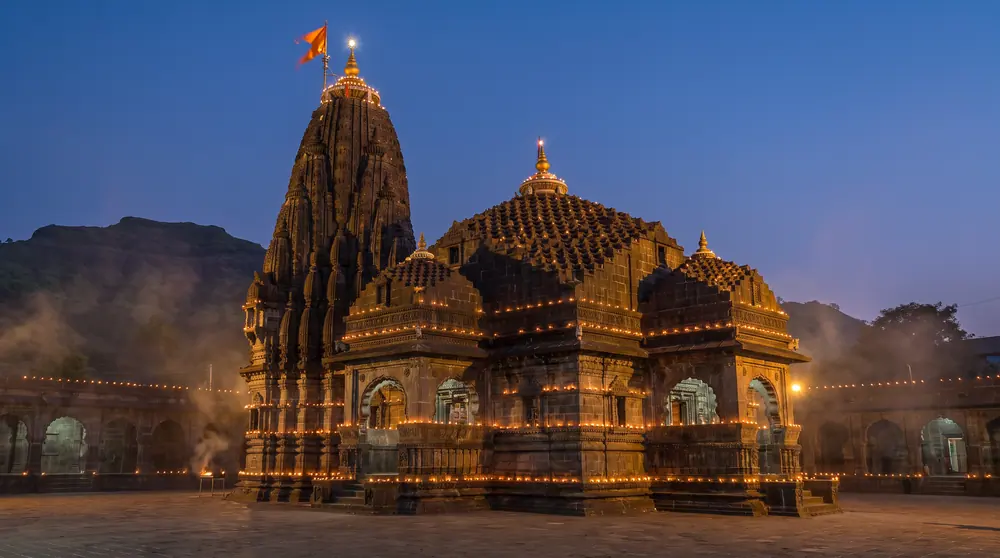
What Is a Jyotirlinga? Trimbakeshwar's Place Among the Twelve
The meaning of a Jyotirlinga, the story of Shiva's pillar of light, the twelve shrines, and why Trimbakeshwar holds a special place among them.
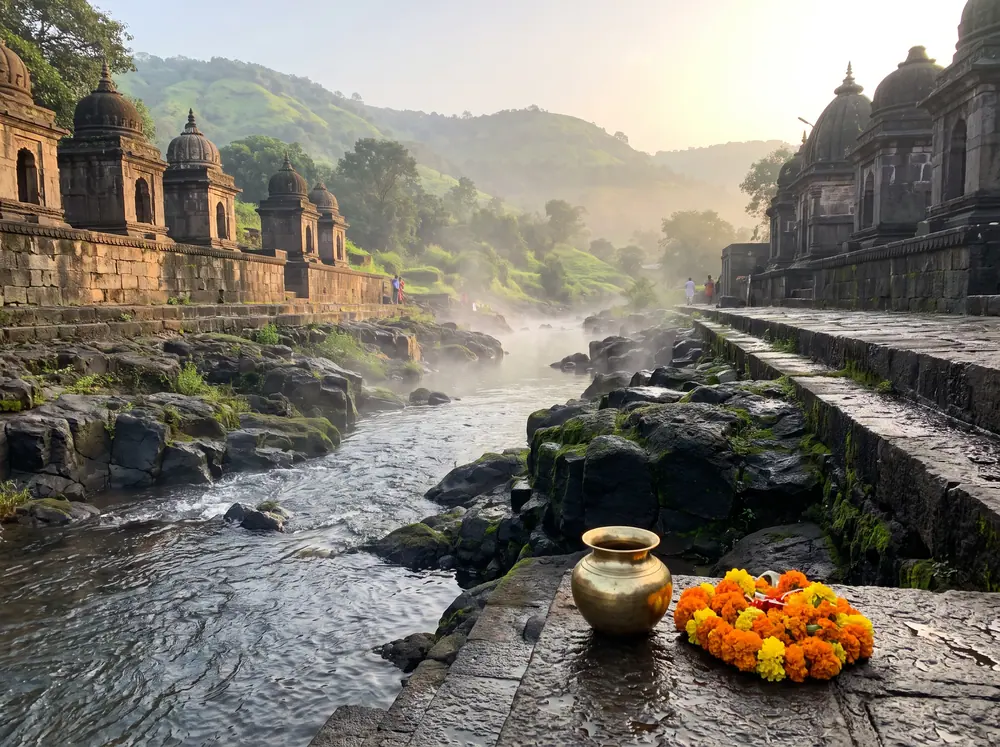
The Origin of the Godavari at Trimbakeshwar
How the Godavari, the Ganga of the South, rises on Brahmagiri: the legend of Sage Gautama, Gangadwar, Kushavarta Tirth, and the river's long journey to the sea.
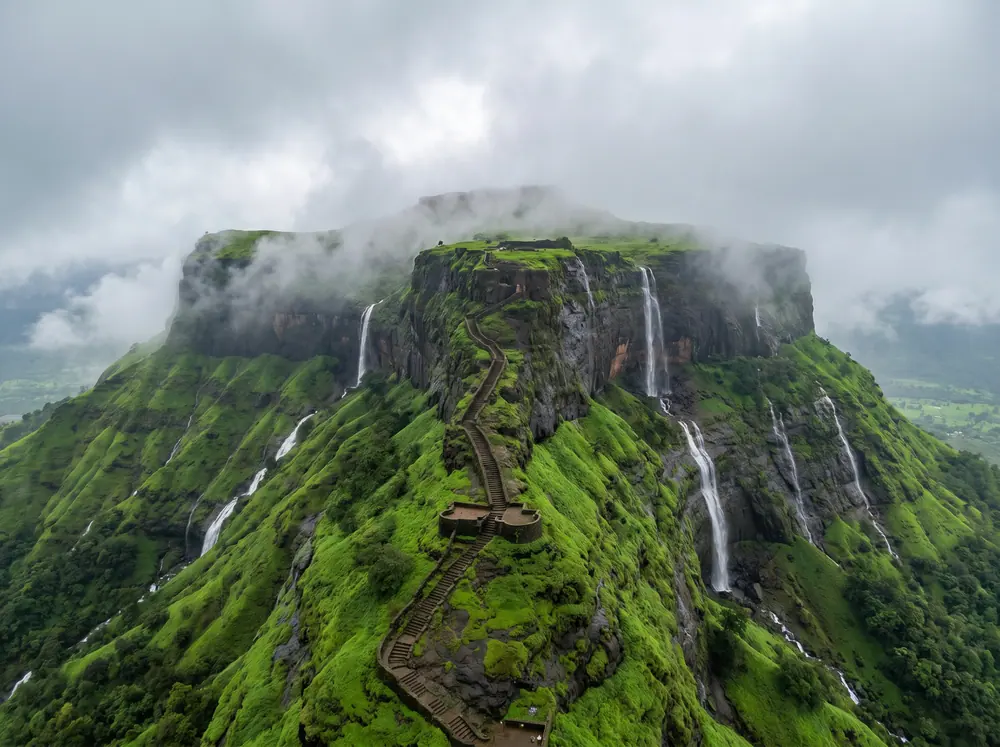
Brahmagiri: The Sacred Hill Above Trimbakeshwar
The hill of Brahma, source of the Godavari: its legends, the climb to the river's source and Gangadwar, the Shravan pradakshina, and how to visit safely.